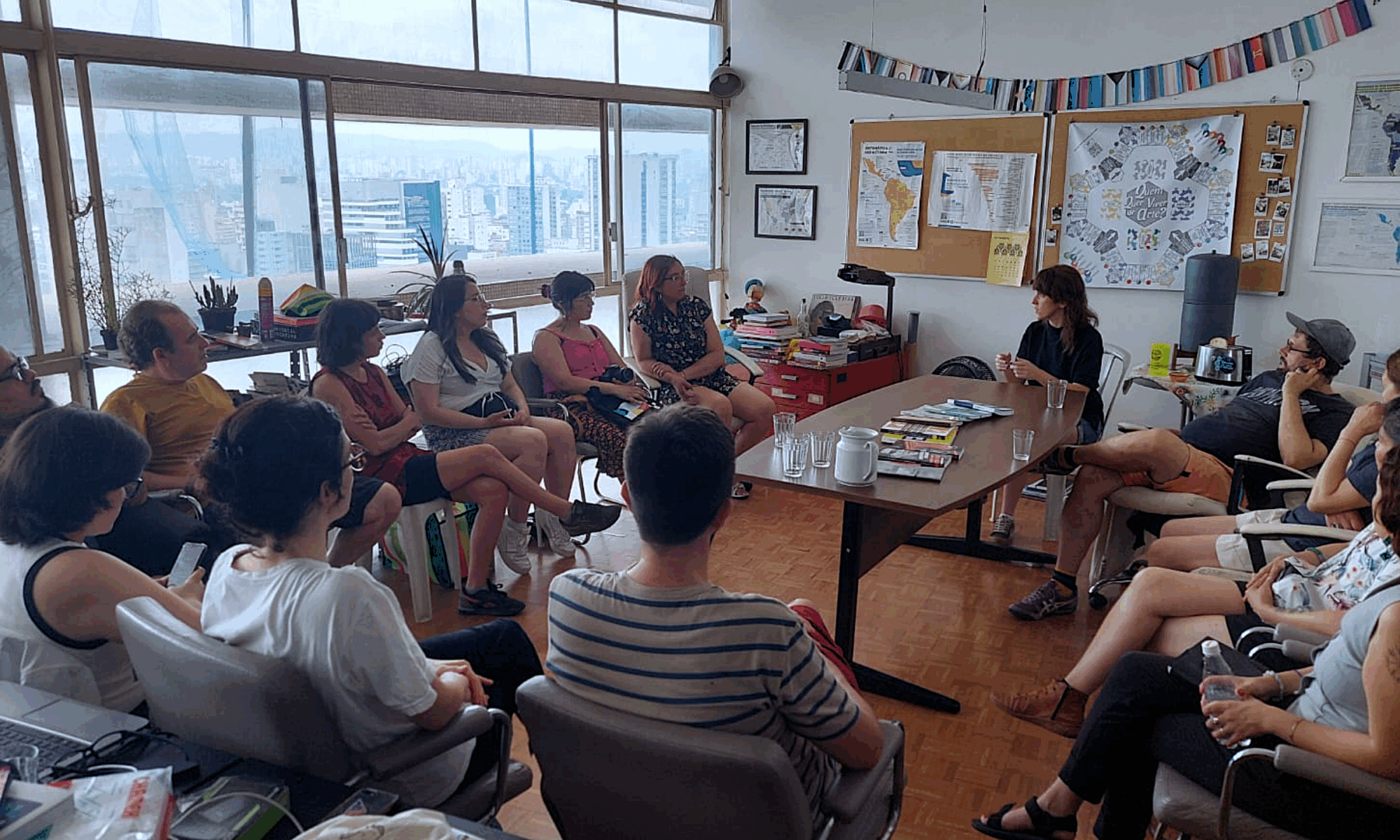
On this Uberbau_house page, we present a summary of information about past residencies, which have hosted more than 207 art workers from 27 countries and 63 cities, and allow you to learn about the work carried out in residence, offering a valuable resource for those interested in contemporary art and research. carried out in this area.
In these years, we have hosted collective and collaborative work activities and residencies, such as the Diploma in Art Applied to Society, Systematic and Seductive, and Espacio de Fala, addressing topics such as art and social processes, biennials of contemporary art, gender, sexuality, race, and class.
The Final Research Presentations made by participants since 2016 are available in the section, and the Map of Participants in residencies from 2016 to 2026 provides an overview of the diversity and scope of collaborations in Uberbau_house.
This Uberbau_house page looks at past activities and residencies, which have addressed relevant topics in contemporary art, such as art and social processes, contemporary art biennials, gender, sexuality, race, and class.
QUICK ACCESS TO CONTENT
-
- Map of Participants in the Uberbau_house residences 2016 – 2026
- Diagram of participants organized by research topic. 2016 – 2026
- Final presentations 2026
- Final presentations 2025
- Final presentations 2024
- Final presentations 2023
- Final presentations 2022
- Final presentations 2016 – 2021
- Who has participated in the residency?
- Informative fanzine 6 years of Uberbau_house (2016 – 2022)
Instagram | Facebook | TikTok | LinkedIn
conversation group on WhatsApp | conversation group on Telegram.
Do you want to participate in the Uberbau_house Residencies?
By following these links, select the type of residence, duration period, and available dates.
-
- Art research residency (18 and 45 days long)
- Contemporary art production residency (2 months)
- LONG TERM RESIDENCES art research residencies (3 and 6 months long)
Map of participants at Uberbau House Residences. 2016 – 2026
v. 1.3 – January 2026
Diagram of participants organized by research topic. 2016 – 2026
v. 1.3 – January 2026
Final Presentations 2026
Final Presentations 2025
Final Presentations 2024
Final Presentations 2023
Final Presentations 2022
Final Presentations 2016 – 2020
Who Has Participated in Uberbau_house Residencies?
More than 200 art workers have already participated in the Uberbau_house Contemporary Art Research Residency.
Uberbau_house has hosted the following collective work programs and residency initiatives:
- Diplomado Arte Aplicada a la Sociedad (2020 and 2021) – Art and social processes.
- Sistemática y Seductora (2018) – Contemporary art biennials.
- Espacio de Fala (2019, 2020 and 2022) – Gender, sexuality, race, and class.
- Habeas Data (2016, 2017, 2018 and 2019) – Archives and data research.
- Acción / Transacción (2018 and 2019) – Art economy and the art market.
- The Real Fake (2017) – Art and social processes.
Uberbau_house Residents 2026 / Research
- Johanna Boya (Colombia / Chile) – Collage and Decolonization: Narratives for Dignifying the Archive.
- Josué Torres Chávez (México) – Circus in My Hands. A socio-educational circus intervention model.
- Yanne Horas (Germany) – What Comes After Contemporary Art? Towards a New Political Economy.
- Katherine Moya Farías (Chile / Argentina) – Reclaiming «Fruna»: Deviation and Vulgarity as Spatial Methods for Overcoming Cultural Domination.
- Guillermina Bravo (Argentina) – Memory Is a Toy. Collective strategies for assembling and disassembling memory.
- Epifania Queta (Angola / Netherlands) – Blackness in Context: Geography, Culture, and the Gaze of Global Art. An examination of how her position as a dark-skinned Black woman shifts according to geographical and cultural context, and what these changes reveal about the construction of Blackness within the predominantly white art world.
- Majo Abreu (Guanajuato, México) – Building Community Relationships: Diagnosis and Proposals for Caja de Cambios (Guanajuato, Mexico). A research project aimed at strengthening community ties and enhancing the social impact of this space.
- Rita Gajardo (Rancagua, Chile) – Professional strategies for her work as an artist, cultural manager, and producer within the local art scene of Rancagua, Chile. An analysis focused on career development and sustainability in a regional cultural context.
- Sara Pirani (Italy/ Ireland) – Ideas for Delaying the End of Humanity at the Hands of Machines. Her presentation explores how contemporary art can operate as a mechanism for negotiation within anthropocentric systems, questioning our role in the face of technological advancement.
- Carmin Santos (Argentina) – Research on the knowledge of Indigenous women in Brazil during the 16th and 17th centuries as a way of challenging the colonial gaze.
- Elisabeth Verdugo (Neuquén, Argentina) – Developing a publication that brings together her work on personal experiences of nomadism and the history of migration in Argentine Patagonia.
- Federico Mattioli (Argentina) – Examining how different arbitrary conceptions of time produce distinct forms of subjectivity.
- Kiki Pertiñez (Venezuela / Spain) -Field research conducted in Brazil for the development of the +Latina Latin American Contemporary Art Festival in Europe. Their participation is supported by Boom! Art Community and Festival +Latina.
- Luis Luján (Chihuahua, México) – Imagining new dynamics for collective editorial production and systematization processes with migrant communities.
- Oscar Manriquez (Spain) -Field research conducted in Brazil for the development of the +Latina Latin American Contemporary Art Festival in Europe. Their participation is supported by Boom! Art Community and Festival +Latina.
Uberbau_house Residents 2025 / Production
- Cleo Fuentes (Chile)
Uberbau_house Residents 2025 / Investigation
- Joaquín Henríquez Valdebenito (Santiago de Chile, Chile) – Analysis of curatorial practices and models in Chile. The relationship between the Art System and Local Scenes.
- Georgina Sánchez Celaya (Ciudad de México, México) – Performance, Ritual, and Environmental Struggles in Latin America. Case studies and theoretical contributions.
- Charlotte Rohde (Germany) – The Soft Shell of a Word™ – On Writing Desire (Part 2) and the Economy of Linguistic Control.
- Ana María Bernal Cortés (Ibagué, Colombia) – Interactions between curatorship and mediation in biennial events in Colombia and Brazil in 2025 and their politics.
- Manuel Saldaña Minchala (Ecuador) – Diagnosis of the Local Art Scene for the development of Trayectoria.
- Hannah Westphal (Germany) – Exploring how visual storytelling and performance art become pathways for collective regulation and healing through the lens of Brazilian cultural practices and contemporary artists.
- Ana Carolina Benitez Bravo (Quito, Ecuador) – Open Archive. Memory of artistic practices by women and LGBTQI+ people in Ecuador and Brazil since 2020.
- Lorena Santamaría (Cuenca, Ecuador) – Designing models of horizontal pedagogies and artistic creation within the urban ecosystems of Cuenca (Ecuador).
- Claudia Vidal Sepúlveda (Santiago de Chile, Chile) – Transformations in exhibition spaces. A study of institutions, mediation devices, and audiences in contemporary art.
- Cecilia Andino (Chaco, Argentina) – Lataxac Residency: Art, Territory, and Community. Residency models and community practices in Latin America.
- María Gavaldon (Ciudad de México, México) – How? An approach to production strategies in contemporary art from the perspective of the visual and performing arts.
- Érika Venecia Ramirez García (Oaxaca, México) – Living Tradition: Dance and Costume Through Art and Culture. The evolution of dance and costume in Mexico from the pre-Hispanic period to the present.
- olgaMargarita Dávila (Ciudad de México, México) – Relationality(ies): An approach to three São Paulo Biennials (Brazil).
- Mitchel López Granados (Salamanca, México)– Curatorial criticism as an intellectual practice that finds its materiality through writing.
- Victoria Papagni (Buenos Aires, Argentina / Zurich, Switzerland) – Tension and complementarity between career strategies and production strategies.
- Majo Abreu (Guanajuato, México) – Diagnosis of agents, institutions, and communities to strengthen relationships within Local Scenes.
- Arasy Benítez (Asunción, Paraguay / Serra da Mantiqueira, Brazil) – Micro-experimentación Social Curatorial para una accesibilidad participativa.
- Lucía Ramundo (Buenos Aires, Argentina) – Curatorial social micro-experimentation for participatory accessibility.
- Paula Martínez Montt (Concepción, Chile) – Ecologies in Latin America’s sacrifice zones.
- Luis Daniel Jaramillo Vázquez (Salamanca, México) – On grand hyperstitions.
- David Duponchel (Lima, Perú) – Comparative analysis of the representation of Death in cinema.
- Luis Mata (Margarita / Caracas, Venezuela) – Analysis and organization of artistic production.
- Susan Elizabeth Rocha Ramírez (Quito, Ecuador) -Production of votive art in Ecuador.
- Cristian Hidalgo (Pasto, Colombia) – How can contemporary art and documentary function as participatory systems in situated contexts?
- Pryianca Ambalvi (Goa, India) – Cultural production processes and nonfiction writing on migration, the caste system, and gender/sexuality. Relationships between autobiography, belonging, and collective processes.
- María de la Paz Heredia (Zapala, Argentina) – Visual language tools for identifying the limits of cultural construction in relational education.
- Alma Sofía Velázquez García (Querétaro, México) – Contemporary art produced over the last ten years by Latin American women artists as a catalyst for reflections, exercises, and dynamics that foster critical thinking among adolescents.
- Hastur Mora (Pasto, Colombia) – Analysis of how the concept of identity has changed over time in direct relation to the development of information technologies.
- Carlos Silva (Ciudad de México, México) – Social movements and popular artistic representations in Mexico and Brazil.
- Claudia Piquet (La Plata, Argentina) – Towards the collective experience of contemporary public art.
- Esteban Vivalda-Matus (Santiago de Chile) – Artistic intervention in public spaces for the creation of socio-political experiences.
- Ivone Flores Balseca (Quito, Ecuador) – Notes on light and sound in urban environments.
- Alejandra Karina Flórez Beyona (Bogotá, Colombia) – Dialogue between literature and objecthood. Tools for supporting the evaluation of an artist’s book.
- Blú Azcue (Guanajuato, México) – Assemblies to generate community agreements and consensus for the development of public policies.
- Claudia Marcela Cadena Sandoval (Toluca, México) -Dynamics of cooperation and collectivization within organized communities.
- Leonardo Glenza (Buenos Aires, Argentina) -The relationship between music and cosmology in Guaraní cultures.
- Carmen Mendoza Chávez (Ciudad de México, México) – Career strategies and the consolidation of prestige within the art system.
- Camila Cuervo (Buenos Aires, Argentina) – Text as Image: Communities and convergences.
- Luz Moyano (Buenos Aires, Argentina) – Career strategies and network building.
- Luis Lujan (Chihuahua, México) – Relationships with migrant communities in transit and processes of identity formation.
- Gonzalo Zurita (Quito, Ecuador) – Memory and political movements.
- Elisabeth Verdugo (Neuquén, Argentina) – Migration processes and nomadism.
Uberbau_house Residents 2024 / Investigation
- Mel Gross (Tyler, Estados Unidos) – Ephemerality and Fluidity. Aquilombar as a topological process.
- Jada Imani (Oakland, Estados Unidos) – Bamboo SZN (A Relaunch). Cultivating locational, creative, and financial freedom.
- Hugo Palmar (Amsterdam, Netherlands) – Appearing Together [Genealogy of a Syndrome]. Connecting the paintings of Albert Eckhout and Frans Post from the period of Dutch colonial rule in Brazil, together with other historiographical references, to the concept of Dutch Disease.
- Hannah Hughes (Los Angeles, Estados Unidos)
- María Alejandra Daza (Medellín, Colombia) – Voices of Water. A traveling museum through recycling.
- José Antonio Torres (Lima, Perú) – The relationship between memory and popular music.
- Alejandro Paz Romero (Bogotá, Colombia) – A study of pop culture through the analysis of its mythology.
- Naledi Wiberg (California, Estados Unidos) – Queer dimensions of art and their implementation.
- Karen Lorena Palacios (Bogotá, Colombia) – Developing a festival model dedicated to light in public space.
- Dyan del Rivero Terán (Ciudad de México, México) – A historical analysis of Mexico’s private cultural institutions.
- Alberto Jiménez Meléndez (Bogotá, Colombia) – Vertical photography as a structure for post-photography.
- Wladimir Ojeda Sendra (Rosario, Argentina) – The political networks behind forest fires.
- Daniel Benoit (Montevideo, Uruguay) – Montevideo’s local art scene and possibilities for market development.
- Christiana Dafni Tatsi (Athens, Greece / Madrid, Spain) – Analysis of encrypted language, calligraphy, and the occupation of public space.
- Xavier Delgado (Quito, Ecuador) – Queer epistemology for the performing arts.
- Ricardo Caicedo (Cali, Colombia) – Analysis of masculinity in pagan rituals connected to rivers in Colombia.
- Joan Soto (Concepción, Chile) – Queer architecture and non-normative spaces.
- Raúl Eduardo Balderrama (Chihuahua, México) – Analysis of public policies for dignity and social respect.
- Alejandro Loiacono (Buenos Aires, Argentina) – Models for the installation and circulation of painting.
- David Duponchel (Lima, Perú / France) – Management and conceptual models for documenting traditional Peruvian rituals.
- David Samaniego Almeida (Quito, Ecuador) – Transmedia devices for collaborative work between art and community.
- Denise Koziura (Quilmes, Argentina) – History of art criticism in Argentina.
- Miriam Díaz Manzano (Puebla, México) – Discussions on ableism and the creation of welcoming spaces for difference through artistic practices.
- Cecilia Andino (Chaco, Argentina) – Models of community-based art practice through muralism.
- Alejandra Díaz Rodríguez (Bogotá, Colombia) -Research on gender-based violence and artistic practices.
- María Paula Botero (Bogotá, Colombia) – Contemporary art pedagogy for teacher emancipation.
- Paz Escadon Bossi (Santiago, Chile) – Art and culinary practices in Latin America.
- Ana Carillo Tureo (Concepción, Chile) – Pixação and urban art in São Paulo.
- Isabela Parra (Quito, Ecuador) – Systematization of Ecuador’s photographic and audiovisual archive.
- David Caicedo (Cali, Colombia) – Fictions of a dystopian tropical future.
- Fabiana Alonso (Buenos Aires, Argentina) – Curatorship and analysis of ableist discourse.
- Fernando Zerraga (Trujillo, Perú) – Field research.
- João Parente (Manaos, Brazil / Lisboa, Portugal) – Research methodology for one’s own artistic production, focusing on subjectivity and fiction-making.
- Laura Puerta Barco (Manizales, Colombia) – Work and funding strategies within the art market.
- Cecilia Rejtman (Lima, Perú) + Nadia Isabel Callau Montero (La Paz, Bolivia) – Feminist epistemology for understanding the power and oppression of structural violence.
- Jorge Luis Rincón Roberto (Bogotá, Colombia) – Visibility of the Indigenous LGBTQIAPN+ population.
- Yoalli Quetzal Alfaro (CDMX, México) – Pedagogical strategies against oppression.
- Jenny Alexandra Prado Bernal (Bogotá, Colombia) + Mauricio Colin Castillo (CDMX, México) – Changes in the perception of pictorial space through the use of technology.
-
Uberbau_house Residents 2025 / Production
- Gina Bello (Guanajuato, México)
- Andrés Hadeser (Quito, Ecuador)
- Guillermo Reyes (Quito, Ecuador)
-
Uberbau_house Residents 2024 / Production
- Dafne Valdivia Yllades (Guanajuato, México) – The relationship between nature and private property.
- Mitzi Reyna (Ciudad de México, México) – Participatory art spaces for conversations about the undesirable.
- Mara Bravo (Barranquilla, Colombia)
Uberbau_house Residents 2023 / Investigation
- Camila Lucero (Concepción, Chile / Basel, Switzerland) – The narrative of images.
- Gabriela Hijar (Chihuahua, México) – Ceramics and sound.
- Henrique Fagundez (Canoas, Brazil) – Images and artificial intelligence.
- Jimena Granados (Ciudad de México, México) – Containment strategies in public space.
- Kiana de Tramontana (Lima, Perú) – How to create an art residency.
- Adalí Torres (Lima, Perú) – Representations of trans masculinity in reggaeton music.
- Felipe Ortiz (Santiago, Chile) – Muralism and public policy.
- José Castillejo (Barranquilla, Colombia) – Violent conflicts in Latin America.
- Mayte Miranda (Ciudad de México, México) – Subjectivity in social media.
- Natalia Documet (Lima, Perú) – Common understandings of neurodivergence in popular culture.
- Pierre Dalpé (Montreal, Canadá) – Representations of subjectivity and masks in photography.
- Renato Almeida (São Paulo, Brazil) – The visuality and discursivity of colonization in Latin America.
- Mitzi Reyna (Ciudad de México) – Analysis of performance and dérive strategies in public space.
- Ana del Águila (Tijuana, México) -Visual orders and the looting of archaeological artifacts.
- Parker Brookie (Estados Unidos) – Marginalized subjectivities, women, and LGBTQIAPN+ people during Latin American dictatorships.
- Dayana Lamb (Bucaramanga, Colombia) – Art, ecology, and community in river territories.
- Graciela Álvarez Maroccolo (Buenos Aires, Argentina) – Career strategies in art, culture, and sex work.
- Mafer Ortiz Ballarta (Lima, Perú) -Relationships between music and contemporary art.
- Cristina Carrasco (Cuenca, Ecuador) – Institutional frameworks and heritage policies for contemporary art.
- Manuel Vázquez Ortega (Mérida, Venezuela) – The history of Venezuelan art in recent decades.
- Adriana Cesar (Montevideo, Uruguay) – Family genealogy from a feminist perspective.
- Billy Klotsa (Greece / London, England) -A documentary on non-binary identities in urban environments.
- Carlos Guzmán (Cachipay, Colombia) -Art, sustainable economies, and ecology.
- José Antonio Torres (Lima, Perú) – The relationship between music and painting.
- Stefany Jaramillo (Bogotá, Colombia) –
- Yunuen Díaz (Morelos, México) – Traces of colonization in popular gastronomy.
- Fernando Colman (Asunción, Paraguay) -The history of the local art scene in Asunción, Paraguay.
- Jorge Augusto Gamarra (La Paz, Bolivia) – Analysis of masculinity in relation to architecture and graphic practices.
- Lucina L.Pedrozo (Ciudad de México, México) – The history of Latin American video art.
- Marcos Jinguba (Luanda, Angola) – Relationships within the art system and networks between Africa and Latin America.
- Mayra Huerta (Guadalajara, México) – Art, culture, and social processes.
- Manuel Vázquez Ortega (Mérida, Venezuela).
- Ximena Pita (Rafaela, Argentina) – Comparative study of biennial institutions in Latin America.
- Yinna Higuera (Quito, Ecuador) – Building a network around the photobook format.
- Tania Guadalupe Martínez Trujillo (Ciudad de México, México) – Inclusive pedagogical models through artistic practices.
- Fabiana Puentes (Montevideo, Uruguay) -The relationship between political events and artistic processes in Latin America.
- Gabriel Xillovich (Bahía Blanca, Argentina) – Ageism and sexual practices in the queer community.
- Lucia Scarselleta (La Pampa, Argentina / Londres, Inglaterra) – R.A.R.O. Scholarship – The history of Gaucho braiding.
- Mónica Martínez (Rosario, Argentina) – Methodologies for object theatre production.
- Gil Mualem-Doron (Londres, Inglaterra) – Independent management practices linking art and community.
- Geo Moon (Seúl, South Korea) – Technology, music, and sound.
- Nina Kraus (Berlín, Germany) – Feminist influences on art institutions and curatorial practice.
Uberbau_house Residents 2022 / Investigation
- Francisca Paris (Puerto Montt, Chile) – Investment models for art and culture.
- Daniela Stevens (San Luis Potosí, México) – Career strategy.
- Ricardo Caicedo Cardona (Cali, Colombia) -Representations of masculinities in photography.
- Renan Teles (São Paulo, Brasil) – Afrofuturism and identity formation in racialized communities.
- Verónica Zapata (Santiago de Chile, Chile) – Pedagogical models based on artistic processes.
- Aaron Jiménez (Ciudad de México, México) – Contemporary opera.
- Alejandro Orozco (Ciudad de México, México) -Diagrammatic thinking.
- Ale Sotelo (Lima, Perú) – Representations of the LGBTQIAPN+ community.
- Miguel Keerveld (Surinam) – Curatorial models for political ecology and climate change.
- Rosario Capanegra (Buenos Aires, Argentina) – Architecture, urbanism, and contemporary art.
- Gianna Salamanca (Concepción, Chile) – Political ecology and social change.
- Julian Cardona (Medellín, Colombia) – Queer epistemology.
- Mía Zavalia (Pilar, Argentina) – Poetic production models.
- Mónica Romero (Bogotá, Colombia) – Politics of care.
- Sergio Gerson Zamora (Morelos, México) – Alternative methodologies for narrating the history of art.
- Yumi Fukuda (Japan) -Identity processes within the Japanese migrant community.
- Tin Ayala (Quito, Ecuador) – Industrial design and critical culture.
- Astrid Suárez (Medellín, Colombia) – Community-based practices addressing forced disappearance in Colombia and Mexico.
- Beatriz Paiva (Belem, Brasil) – Black subjectivity in Northern Brazil.
- Mika Sampaio (Teresinha, Brasil).
- Lennyn Santacruz (Quito, Ecuador) – The history and methodology of art education in Latin America.
- Alexandra Trujillo (Quito, Ecuador) – Career production and legitimization processes.
- Tatyana Zambrano (Medellín, Colombia) – Production processes surrounding a labor union movement for artists.
- Ely_dd (Buenos Aires, Argentina) – Research on guttural sound.
Uberbau_house Residents 2021 / Investigation
- Andrés Ovelar (Asunción, Paraguay).
- Ximena García (Ciudad de México, México)
- Andrea Chávez (Morelia, México).
- Alberto Patiño (Lima, Perú).
- Sofía Enríquez González (Viña del Mar, Chile)
- Cecilia Coddou y Fernanda Radetich (Santiago de Chile, Chile).
- Mariane Beline (São Paulo, Brasil).
- Elisabeth Verdugo (Cipolletti, Argentina).
- Karem Morales (Santiago de Chile) – comparación entre las políticas públicas chilenas y brasileñas.
Uberbau_house Residents 2020
- Miguel Keerveld (Commewijne, Suriname) – el ser humano como un cyborg en relación con las ciudades.
- Francisco García Villavicencio (Lima, Perú) – arte y pedagogía.
- Abari Antonio Ruiz (Tepic, México) – el valor del objeto de arte.
- Pamela González (Tucumán, Argentina) – gestión autónoma en una comunidad de arte.
- Uilton Júnior (São Paulo, Brasil) – historia del arte negro en Brasil.
- Camila Lacroze (Montevideo, Uruguay) – ilustración y pintura contemporánea.
- Lyzú Cárcamo (Valparaíso, Chile) – feminismo aplicado para arte y cultura.
Uberbau_house Residents 2019 / Investigation
- Lía Arenas (Santiago de Chile) – Cultural management as a mobile body in space.
- Wynnie Mynerva Mendoza (Lima, Perú) – The LGBTQIA+ community in relation to religious hegemony in Peru and Brazil.
- Viviana Errecalde (San Martín de los Andes) -The local art scene of San Martín de los Andes, Argentina.
- Luis Enrique Zela-Koort (Lima, Perú) – The relationship between capitalist machinery, nature, and the construction of subjectivity.
- Manuel La Rosa (Santiago de Chile) – The relationship between nature and technology in contemporary art.
- M. Román (Lima, Perú) -Contemporary art and normative social institutions.
- Andrés Argüelles (Lima, Perú) – The question of painting in contemporary art.
- Heleen de Hoon (Netherlands) – Contemporary art in public spaces.
- Martha León Nava (Ciudad de México, México) – Art residency and community models.
- Alexandra Mora -Úrsula Ramirez Giraldo – (Manizales, Colombia) – Journalistic clowning and performance in the Colombian art scene.
- Nancy Alvarado (Tucumán, Argentina) – Ceramics in the tension between craft and contemporary art.
Uberbau_house Residents 2016-2017 / Investigation
- Juan Fernando López (Bogotá, Colombia) – Economics in independent art management.
- Laura Carvalho (São Paulo, Brasil) – The relationship between color, architecture, and context.
- Dafne Valdivia (Guanajuato, México) – Formal institutions vs. independent art management.
- Dana Ferrrari (Buenos Aires, Argentina) – The history of the artist’s role.
- Jazmin Saidman (Buenos Aires, Argentina) – Pedagogy and teaching methodologies in art.
- Guillermo Rodríguez (San Juan, Puerto Rico) -Art and technology
- Leonel Mittmann (Porto Alegre, Brazil) – Pixação, graffiti, and urban art.
- Abhishek Panchal (Mumbai, India) – The role of the artist-educator.
- Estíbaliz Barato (Madrid, Spain) – Analytical models for artistic production.
- Andrea Ospina (Manizales, Colombia) – Arts management, cultural management, and the temporary autonomous zone.
- Fernanda Avendaño (Santiago de Chile) – Architecture and the social body.
- Natalia Murcia (Bogotá, Colombia) – Contemporary art as a research methodology.
- Silvia Mariotti (Milán, Italy) – The relationship between visual and literary production.
- Naoko Mabon (Scotland, UK) – The construction of Japanese identity within Brazilian culture.
Uberbau_house Residents 2018 / Investigation
- Michel Marx (Montevideo, Uruguay) – The role of the artist and the Local Art Scene of Montevideo.
- Andrea Ferrero (Lima, Perú) – Memory processes in Latin America.
- Romina Estecher (Buenos Aires, Argentina) – Recurrence in artistic production processes.
- Pablo Foladori (Buenos Aires, Argentina) – The relationship between opera and contemporary artistic practices.
- Felipe Núñez (Oaxaca, México) – The possibility of a manifesto for contemporary painting.
- María de los Ángeles Otarola (Mar del Plata, Argentina) – Cultural management and arts management.
- Majo Vidal (Buenos Aires, Argentina) – Art and feminism.
- Jesús Jimenez (Morelia, México) – Concrete poetry and violence.
- Tarix Sepúlveda (Santiago de Chile) – Architecture.
- Mateo López Imán (El Bolsón, Argentina) – Linguistic genocide. Symbol, Power, and Contemporary Art in Latin America.
- Genietta Varsi (Lima, Perú) – Discipline and the domestication of the human body.
- Frances Munar (Lima, Perú) – The Architecture of Sound. Dialogues between codes and intersubjectivity in Latin America.
Uberbau_house Zine: 6 Years (2016–2022)
Saltar al contenido del PDF
[español] [portugues] [english]
Would you like to participate in the Uberbau_house Residencies?
| Contemporary Art Research Residency | Contemporary Art Production Residency | Long-Term Contemporary Art Research Residencies |
Talk to us on whatsapp/ telegram